Best Base for Washington Pass Hikes
Last updated: August 2026.
Fast Answer: Where Should You Stay?
Choose Mazama when getting parked early is the priority. It is the best base for repeated mornings at Blue Lake, Rainy Pass, Maple Pass, Cutthroat, Washington Pass climbing routes, and other high-country trailheads.
Choose Winthrop for the best overall balance. You give up some morning time compared with Mazama, but gain more lodging, restaurants, gear support, town services, and flexibility when the hiking plan changes.
Choose Twisp when full grocery shopping, self-catering, pharmacy or clinic access, and a longer practical stay matter more than being closest to the trailheads.
Choose a west-side base only when Washington Pass is one deliberate day inside a broader Newhalem, Diablo Lake, Ross Lake, or Highway 20 trip. It is usually the wrong choice for several parking-sensitive hiking mornings.
Still unsure? Book Mazama for a hike-first trip. Book Winthrop for a complete vacation.
The best Washington Pass base is not simply the town with the shortest mapped drive. The real question is how much margin you need before a limited trailhead lot fills, what your group needs after the hike, and whether pass country is the center of the trip or only one part of it.
This guide compares Mazama, Winthrop, Twisp, and west-side bases by morning goal and parking risk. It does not repeat full trail descriptions or list every lodging property. Choose the right base here, then use the linked trail and where-to-stay guides to finish the plan.
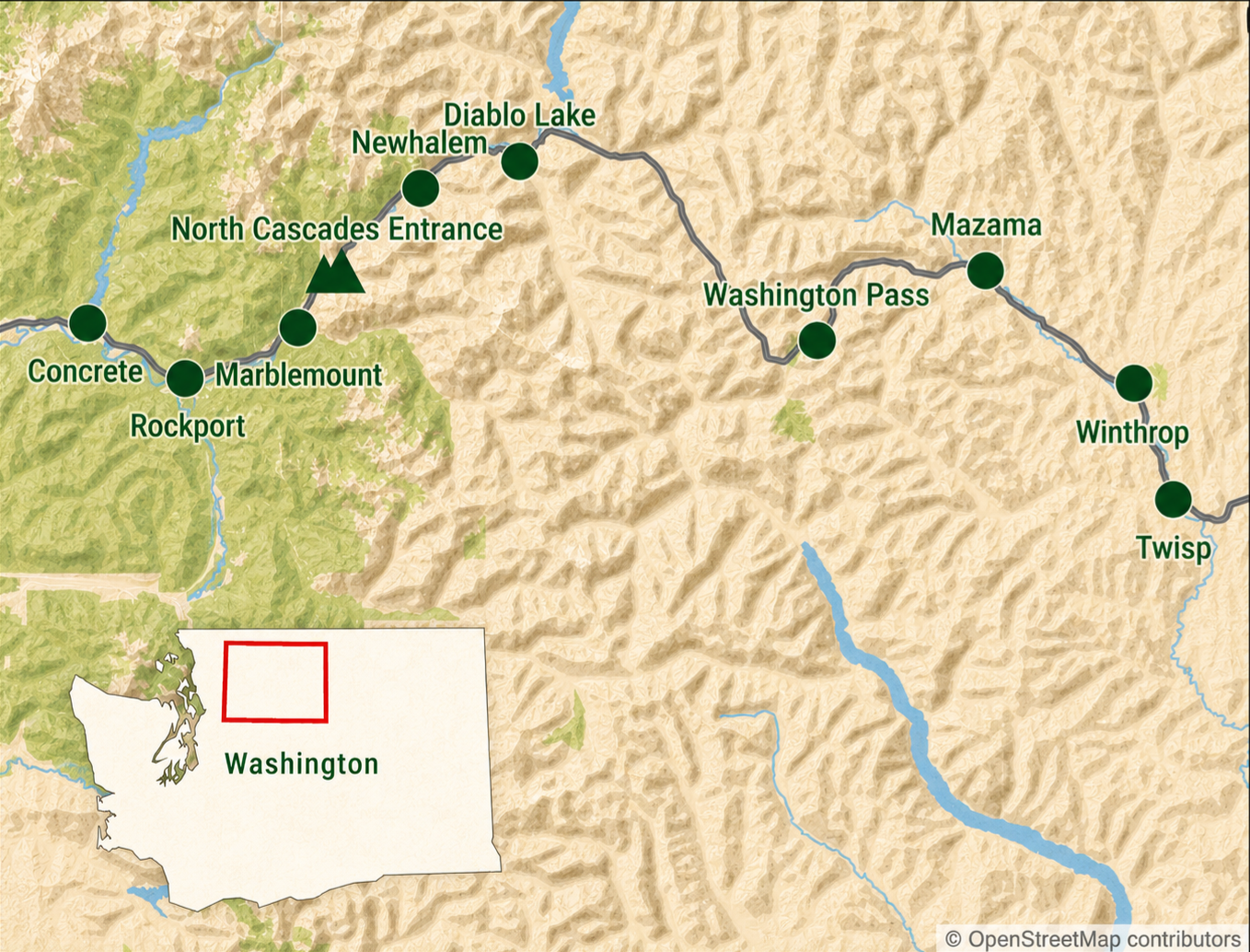
Map: Washington Pass hiking decisions span two regional systems. Mazama, Winthrop, and Twisp approach from the Methow Valley, while Marblemount, Newhalem, and the central park corridor approach from the west.
Choose Your Base by Tomorrow Morning’s Goal
Maple Pass, Rainy Lake, or Lake Ann
Best base: Mazama. Best compromise: Winthrop.
These destinations share the Rainy Pass south parking system. Rainy Lake may be the easier walk, but it does not avoid the parking pressure affecting Maple Pass and Lake Ann.
Use the Rainy Pass guide to choose between the three destinations. Use the Maple Pass guide for the full loop.
Blue Lake
Best base: Mazama. Second choice: Winthrop.
Blue Lake has its own small parking area and is one of the least forgiving plans for a late start. Twisp can work, but the extra lower-valley drive reduces the parking margin you were trying to create.
See the Blue Lake guide for trail difficulty, family fit, parking, season, and larch timing.
Cutthroat Lake or Cutthroat Pass
Best base: Mazama. Second choice: Winthrop.
Cutthroat uses a parking system separate from Blue Lake and Rainy Pass, but its own lot is limited. Treat it as an independent planned destination, not as a guaranteed overflow lot after another trailhead fails.
Use the Cutthroat Lake and Cutthroat Pass guide to choose the shorter lake outing or the longer pass route.
Easy Pass
Best shortest approach: Mazama. Most defensible west-side option: Marblemount.
Easy Pass sits farther west than the other major hikes in this guide. That makes a west-side stay more reasonable than it is for Blue Lake or Cutthroat, especially when the rest of the trip already includes Newhalem, Diablo Lake, or Ross Lake.
Easy Pass still has its own limited trailhead parking. A west-side base changes the drive direction; it does not remove the need for an early plan.
Washington Pass Overlook
Best closest base: Mazama. Best complete stay: Winthrop.
The overlook is a short scenic stop rather than a full hiking commitment. It works for families, non-hikers, late arrivals, and groups that lose a hiking plan to parking or weather.
Use the Washington Pass Overlook guide for accessibility, wind, timing, and viewpoint planning.
Why Mazama Is Best for Parking-Sensitive Mornings
Mazama’s advantage is not that it has better restaurants, more lodging, or deeper visitor services. Its advantage is that it removes a useful section of Highway 20 from the beginning of the day.
Depending on the exact lodging and trailhead, staying in Mazama can save roughly 15–25 minutes each way compared with starting in Winthrop. That may not sound decisive when booking a room, but it matters when Blue Lake or Rainy Pass parking is filling while you are still driving.
Choose Mazama when: two or more mornings target pass-country trailheads; you are visiting on a busy summer or larch weekend; climbing or a long hike requires a very early start; or missing the original parking lot would seriously damage the trip.
Do not choose Mazama expecting a full-service town. Major grocery shopping, pharmacy needs, vehicle problems, broad restaurant choice, and bad-weather entertainment are easier in Winthrop or Twisp.
Handle important supplies before settling in, confirm late check-in instructions, and know what food will be available if you arrive after ordinary business hours.
When Winthrop Is the Smarter Choice
Winthrop is the best overall answer for most visitors because Washington Pass hiking is rarely the only need a group has for an entire stay.
Choose Winthrop when the trip includes one major hiking morning but also needs restaurants, lodging choice, walkable town time, gear shops, rentals, family flexibility, or useful alternatives for someone who does not want to hike.
The morning drive is longer than from Mazama, but it remains practical when you plan backward from the time you need to be parked. The mistake is not staying in Winthrop. The mistake is leaving Winthrop at the time you hoped to reach the trailhead.
Winthrop also absorbs failure better. If weather, smoke, fatigue, or parking breaks the original plan, the town gives the group more ways to use the rest of the day without turning every change into another long drive.
Choose Winthrop when: this is your first Methow trip; different people want different activities; the hike is only one day of the stay; or service backup matters more than saving the final portion of the morning drive.
When Twisp Still Makes Sense
Twisp is not the best base for beating Washington Pass parking, but that does not make it a bad base. It solves a different set of problems.
Choose Twisp when the stay lasts several nights, a full grocery store and self-catering matter, someone needs easier pharmacy or clinic access, or the trip also includes Twisp River Road, arts stops, and lower-valley activities.
The tradeoff is repeated morning driving. Twisp sits below Winthrop, so every trip toward Mazama and Washington Pass begins with an additional lower-valley segment before the mountain approach starts.
Twisp works best when there is one Washington Pass day inside a broader Methow stay. It works poorly when three consecutive mornings depend on limited high-country parking.
Do not assume Twisp is automatically the budget answer. Compare the actual lodging rate against the extra driving and the practical advantages your group will use.
When a West-Side Base Actually Works
A west-side base makes sense when Washington Pass hiking is one part of a west-side North Cascades trip, not when every morning is built around Blue Lake, Rainy Pass, or Cutthroat.
Marblemount is the most practical west-side lodging-town choice. Use it when the trip also includes Cascade River Road, Newhalem, Diablo Lake, Ross Lake, or a dedicated Easy Pass day.
Newhalem or Colonial Creek camping can be better positioned geographically than a Marblemount room. The tradeoff is that these are campground bases with much thinner food, fuel, charging, and late-day service support.
Concrete and Rockport are useful west-side lodging and service bases, but they are generally too far away for a parking-sensitive Washington Pass morning. Choose them for a scenic-drive day, not because they create a competitive Blue Lake or Maple Pass start.
A west-side base becomes especially weak when the group stops repeatedly at Newhalem, Diablo Lake, and Ross Lake before continuing to the trailhead. Those stops may fit a scenic-drive day, but they consume the exact morning margin needed for high-country parking.
Know Which Hikes Share a Parking System
A useful backup must use a different available parking area. Changing trail names does not solve a full lot when both trails begin from the same place.
Rainy Pass south: Maple Pass, Rainy Lake, and Lake Ann use the same main parking system. None is a parking fallback for another.
Rainy Pass north: The north-side Pacific Crest Trail lot is physically separate, but it is still a limited high-demand lot in the same pass area. Do not build the day around moving between the north and south lots after one fails.
Blue Lake: Blue Lake has its own small parking area. Its independence does not make it dependable after Rainy Pass fills; it may already be under equal pressure.
Cutthroat: The Cutthroat Lake trailhead is independent from Rainy Pass and Blue Lake, but its parking is also limited. Treat it as a separate option you have researched, not a guaranteed overflow promise.
Easy Pass: Easy Pass has a separate lot and attracts a somewhat different hiking group, but the lot remains small.
Washington Pass Overlook: The overlook is the strongest nearby low-effort recovery because visits are shorter and parking turns over. It salvages the high-country drive, but it does not replace a full hiking day.
Late Arrival and Full-Lot Rules
The useful planning target is the time you need to be parked, not the time you intend to leave the lodging.
Work backward through driving, breakfast, fuel, bathroom needs, loading children or gear, and any stop your group will realistically make. On the busiest summer and larch-season mornings, Mazama’s time advantage matters because it removes one more failure point before the trailhead.
If Rainy Pass is full: do not switch from Maple Pass to Rainy Lake and assume the problem is solved. They use the same parking system.
If Blue Lake is full: do not circle indefinitely or assume the next famous trailhead will be empty. Washington Pass Overlook is the cleanest low-effort recovery. Cutthroat can be checked as an independent option only when you already understand its parking and route.
If the group starts late: choose a plan designed for a late start. Washington Pass Overlook is more resilient than gambling on Blue Lake or Maple Pass. A shorter stop followed by a Methow Valley afternoon is better than spending the day searching for unsafe or prohibited parking.
Never block travel lanes, emergency access, turnarounds, or signed no-parking areas. A full lot is a trip-planning signal, not permission to improvise a parking space.
Restrooms, Passes, Food, and Fuel Before Dawn
Most of the major Forest Service trailheads in this guide have vault toilets but no potable water. Rainy Pass, Blue Lake, Cutthroat, and Easy Pass normally use Forest Service day-use fee or accepted federal-pass rules. Washington Pass Overlook uses a different fee rule.
Do not try to memorize the full system from this page. Use the North Cascades Fees, Passes, and Permits guide for the current distinction between Forest Service fee sites, National Park Service locations, state parks, campground payments, and backcountry permits.
Use the Highway 20 restroom guide to plan confirmed facilities from either direction.
From Mazama: do not assume every important service will be open before an early departure. Prepare food, water, payment, maps, and fuel the previous evening.
From Winthrop or Twisp: use the deeper service inventory before driving west. Do not turn the extra morning distance into a second delay by adding an unplanned grocery or fuel stop.
From the west side: handle fuel and substantial supplies before the central mountain corridor. Services become much thinner after Marblemount.
Seasonal and Directional Access
“Highway 20 is open” is not a complete access answer. Confirm whether the intended trailhead is reachable from the side where you are staying.
Partial access can preserve a Washington Pass or Methow trip from the east while preventing a west-to-east crossing. The reverse can also leave west-side destinations available while pass country remains unreachable.
An open highway also does not prove that a high-elevation trail is snow-free, that the restroom is uncovered, or that the trailhead is operating normally.
Use the North Cascades Highway access tracker to separate west-side corridor access, Methow destination access, pass-country access, and a complete cross-mountain drive.
Before departure, use Current Conditions for road, fire, smoke, weather, and seasonal-access sources.
Common Base-Choice Mistakes
Choosing by nightly price alone: A modest room-rate difference can disappear after repeated extra driving, supply trips, and limited late-day food options.
Booking Winthrop but leaving too late: Winthrop is a good base. It does not erase the need to plan around the parking arrival time.
Booking Mazama and expecting Winthrop-level services: Choose Mazama for proximity and atmosphere, then prepare for the thinner service system.
Using Twisp for several parking-sensitive mornings: Twisp’s practical strengths do not cancel its lower-valley location.
Treating Rainy Lake as Maple Pass overflow: The hikes share the same parking system.
Treating Cutthroat as guaranteed overflow: Its lot is separate but still limited.
Choosing a west-side room for repeated Blue Lake or Cutthroat days: A west-side base works for a mixed corridor trip, not as the default for an east-focused hiking schedule.
Assuming an open route is open from both directions: Always check access from the actual base.
The Final Choice
Book Mazama when the trip depends on repeated early starts and the best possible parking margin.
Book Winthrop when you want one strong hiking day inside the most flexible overall stay.
Book Twisp when longer-stay logistics, self-catering, grocery access, and practical services matter more than trailhead proximity.
Stay west when Washington Pass is one anchor day inside a broader Newhalem, Diablo, Ross Lake, or Highway 20 trip.
Related Hiking and Planning Guides
This is an evergreen base-choice guide. Parking demand, road access, trail conditions, fees, and facility availability can change. Check the linked current-conditions and destination guides before departure.