North Cascades Wildflower Guide: Bloom Timing by Elevation, Month, and Best Trails
Last updated: May 2026
For most North Cascades wildflower trips, the best question is not “which trail has flowers?” It is “which elevation band is actually ready?” Low forest flowers can start while the high country is still buried, and the classic Rainy Pass, Washington Pass, Maple Pass, and Cascade Pass flower trips usually depend on snowmelt more than the calendar.
This guide is built for practical SR-20 trip planning. Use it to match your month, group, and driving plan to the right flower zone before you commit to a trailhead.
Get the North Cascades newsletter for practical trip updates, new guide releases, and seasonal planning notes before your next Highway 20 drive.
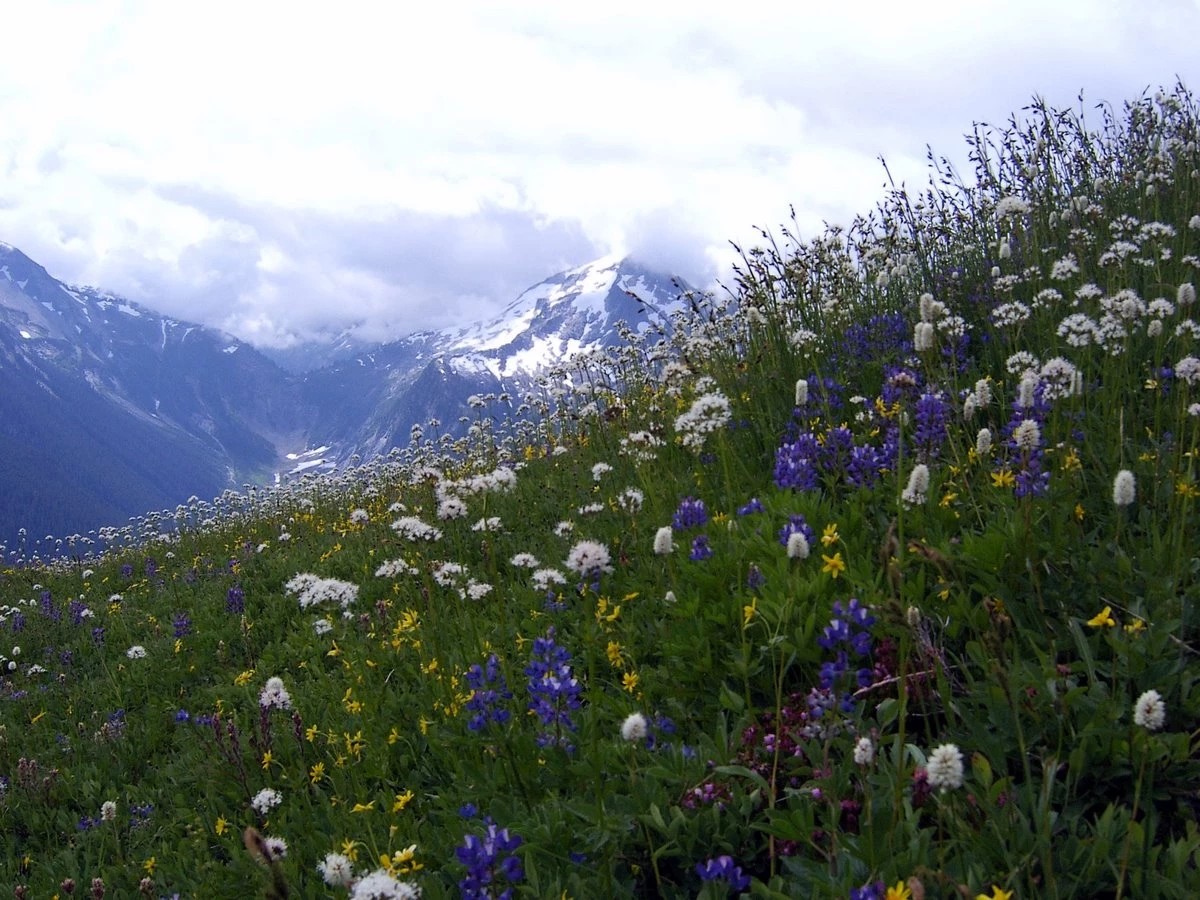
A profusion of wildflowers on Copper Ridge. Photo by NPS/Lin Skavdahl
Quick Decision Guide
Use this page by elevation first, month second, and trail name third. Low-elevation flowers can start months before the alpine meadows. A June flower trip near Newhalem or Diablo is not the same thing as a June flower trip at Maple Pass, Blue Lake, or Cascade Pass.
- April to May: Think low-elevation west-side forest: Newhalem, Diablo Lake, Colonial Creek, Thunder Knob, and nearby lower trails. Do not expect Rainy Pass, Washington Pass, or Cascade Pass meadow bloom this early.
- June: Use caution. Lower and mid-elevation flowers may often in bloom, but classic high-country wildflower hikes are still snow-dependent. June is the month when visitors are most likely to overestimate the passes.
- Mid-July through August: This is the safest general window for Rainy Pass, Lake Ann, Maple Pass, Blue Lake, Cutthroat, Cascade Pass, and other subalpine flower goals, assuming access and trail conditions line up.
- Late August into early September: Expect lingering high-country flowers, asters, heather, and late-season color rather than a guaranteed peak meadow show.
Best quick stop: Rainy Lake is still the easiest short high-country stop once SR-20 is open and the Rainy Pass area has melted out, but do not treat it as the strongest flower evidence on the corridor. It is better as an accessible add-on than as the main reason to drive east.
Best evidence-backed high-country zone: The Rainy Pass / Lake Ann / Maple Pass area has the strongest combination of practical visitor appeal and source-backed flower timing. Early July can still be variable, while mid-July through August is the better planning window.
Best early-season backup: Diablo Lake, Colonial Creek, and Thunder Knob are better choices when the high country is still snowy or the pass-country weather is not worth the drive.
Best “not early, but worth waiting for” option: Cascade Pass and Sahale Arm should be treated as true summer flower hikes. They are not reliable June flower recommendations because road access and trail snow often lag behind lower-elevation spring conditions.
Check current conditions and seasonal access before building a flower day around high-country trails.
Best Wildflower Timing by Month
This is not a peak-date calendar. It is a practical planning guide for where your odds are best by month and elevation.
April: low-elevation west-side flowers
Best areas: Newhalem, Diablo Lake, Colonial Creek, Thunder Knob, and low forest trails along the west side of the corridor.
What this month is good for: Early spring flowers, forest understory bloom, short walks, and backup stops when the higher country is still out.
Common mistake: Driving toward Rainy Pass, Washington Pass, Maple Pass, or Cascade Pass expecting alpine meadows. Those are usually much later plays.
May: low to lower-mid elevations
Best areas: The lower SR-20 corridor, Newhalem-area trails, Diablo-area trails, and other lower routes as snow recedes.
What this month is good for: Early-season color without committing to high-country uncertainty.
Common mistake: Assuming that spring on the west side of Washington means spring at the passes. The pass-country trailheads and ridges are on a different seasonal clock and snow often lingers into June.
June: useful, but easy to overclaim
Best areas: Lower and mid-elevation options, around snowmelt edges, and selected lower trail sections depending on the year.
What this month is good for: Flexible flower trips where you are willing to adjust based on snowline, road status, and trail reports.
Common mistake: Treating June as broadly reliable for Maple Pass, Blue Lake, Cutthroat, Rainy Pass, or Cascade Pass. In many years, June is still too early for the classic high-country flower experience.
July: transition into the high country
Best areas: Rainy Pass, Lake Ann, Maple Pass, Cascade Pass, Blue Lake, Cutthroat Lake, and Cutthroat Pass once meltout is far enough along.
What this month is good for: The start of the dependable subalpine wildflower season, especially from mid-July onward.
Common mistake: Treating early July as guaranteed. Some years, early July still has significant snow in the high country. Mid-July is safer, but still worth checking against current reports.
August: strongest high-country flower month
Best areas: Rainy Pass, Lake Ann, Maple Pass, Washington Pass, Blue Lake, Cutthroat, Cascade Pass, and other higher trails.
What this month is good for: Subalpine meadows, lingering snowmelt-fed bloom, open ridges, and late-summer flower groups.
Common mistake: Expecting lower-elevation forest flowers to still be the main event. By August, the better flower strategy is usually to go higher.
September: lingering flowers, not guaranteed peak
Best areas: High-country trails where asters, heather, and a few late-season holdouts remain.
What this month is good for: Scenic trips, late color, and shoulder-season hiking if weather and smoke cooperate.
Common mistake: Marketing September as broad peak wildflower season. It can still have flowers, but the classic peak meadow window has usually passed.
Best Wildflower Areas by Reliability
Some North Cascades flower areas are stronger recommendations than others because the timing evidence, access pattern, and visitor payoff line up better. Use these reliability notes to avoid treating every pretty trail as equally predictable.
Strong recommendation: Rainy Pass / Lake Ann / Maple Pass zone
Best window: Mid-July through August.
Why it belongs high on the list: This zone has the best combination of visitor appeal, high-country flower terrain, and source-backed timing signals. Lake Ann is especially useful as a timing example because early July can still be snowy, while mid-July can be snow-free and flower-rich in better years.
How to use it: Treat the Rainy Pass area as the main SR-20 flower target once high-country meltout is established. Maple Pass is the stronger full-day hike; Lake Ann is a useful flower-timing anchor; Rainy Lake is the easy short stop in the same general zone.
Use the Rainy Pass and Washington Pass area guide to understand how these stops fit together.
Strong recommendation for peak summer: Cascade Pass / Sahale Arm
Best window: Mid-July into August, with late July and August usually safer than early July.
Why it belongs high on the list: Cascade Pass is one of the strongest North Cascades wildflower destinations once access and snow conditions line up. The problem is timing. Cascade River Road access and trail snow make this a poor early-season recommendation.
How to use it: Recommend Cascade Pass when someone wants a real hiking day, not a quick SR-20 stop. It is a better fit for a flower-focused trip than for a casual highway itinerary.
Use the Cascade River Road guide before building a day around Cascade Pass.
Strong early-season backup: Diablo Lake / Colonial Creek / Thunder Knob
Best window: April through June for lower-elevation flower viewing.
Why it matters: This is the best practical answer when the high country is too snowy, too cold, too windy, or not worth the drive. These stops are not alpine meadow destinations, but they are much more useful for early-season visitors than pretending Maple Pass is ready.
How to use it: Send April, May, and early-June visitors here when they want flowers without high-country uncertainty. Thunder Knob is especially useful for mixed groups, families, and people who want a manageable hike with a real viewpoint.
Use the North Cascades Park Complex guide for Newhalem, Diablo, and nearby stops.
Useful but variable: Blue Lake
Best window: Mid-July through August.
Why it still belongs: Blue Lake is one of the best visitor-friendly high-country hikes near Washington Pass. It gives you alpine scenery and a strong payoff without the longer commitment of Maple Pass.
Why the wording should stay softer: The ecological fit is strong, but direct dated flower evidence is weaker than for Lake Ann or Cascade Pass. Present it as a very good mid-summer high-country option, not as the most evidence-backed bloom predictor.
Useful but variable: Cutthroat Lake and Cutthroat Pass
Best window: Mid-July through August.
Why it belongs: Cutthroat gives visitors a quieter-feeling alternative east of Washington Pass and can work well when the Rainy Pass cluster feels too crowded.
Planning constraint: It is farther east and may involve a gravel spur or a more committing hike depending on whether you choose the lake or the pass. Treat it as a real outing, not a tiny add-on after several other stops.
Short-stop bonus: Rainy Lake
Best window: After the Rainy Pass area has melted out, usually mid-July through August for the broader high-country flower window.
Why it belongs: Rainy Lake is still the best short, accessible-feeling high-country stop for mixed groups. It has paved access, a short distance, and a trailhead setup that works better for casual visitors than most high-country hikes.
Why not to overstate it: It should be presented as a short scenic and accessibility-friendly add-on, not the strongest source-backed wildflower destination on the corridor.
Soft backup context: Mazama and Winthrop lower valley
Best window: May and June for lower dry-side bloom, depending on year and exact location.
Why it belongs: The east side of the crest has drier habitats and different flower timing than the wet west side. Mazama and Winthrop are also useful staging areas for Washington Pass, Cutthroat, and other east-side high-country routes.
Why the wording should stay cautious: These towns are useful for logistics and lower-elevation context, but they should not replace the stronger Rainy Pass, Lake Ann, Maple Pass, or Cascade Pass recommendations without more location-specific flower data.
Use the Winthrop services guide if your flower route continues east of Washington Pass.
How Bloom Timing Works on SR-20
Think in bands, not exact dates. The North Cascades do not bloom all at once. A lower forest trail near Newhalem can feel like spring while a high pass trail is still carrying snow. A ridge near Washington Pass can still have flowers after lower elevations have dried out.
Low elevation comes first. The lower west-side forest corridor around Newhalem, Diablo, Colonial Creek, and nearby trails is the better early-season flower bet. This is where March, April, May, and early June visitors should start thinking.
Mid-elevation follows. As snow retreats, lower and mid-elevation trail sections can become useful before the classic high-country routes are fully ready. This is why June can be good in some places and still too early in others.
High country is usually a true summer story. Rainy Pass, Lake Ann, Maple Pass, Blue Lake, Cutthroat, Washington Pass, Cascade Pass, and Sahale Arm should usually be treated as mid-July through August flower targets. In lingering-snow years, some pockets can shift later.
The common mistake: Visitors hear “North Cascades wildflowers” and aim straight for the passes too early. That only works if SR-20 access, side-road access, snowmelt, trail condition, parking, and weather all line up.
Use the corridor this way: target low elevations in spring, stay flexible in June, and save the high-country wildflower plan for mid-July through August unless current reports clearly show an earlier meltout.
What Flowers You Might See by Season
Use flower groups as a practical planning tool, not as a promise that one species will peak on one trail during one specific week.
Low-elevation spring flowers
Likely timing: Late winter into spring, with April and May most useful for visitors.
Where to think: Low west-side forests around Newhalem, Diablo, Colonial Creek, and nearby lower trail corridors.
Examples: Salmonberry, Indian plum, red-flowering currant, trillium, bleeding heart, marsh marigold, stream violet, and skunk cabbage.
Snowmelt flowers
Likely timing: Usually June or July depending on elevation and meltout.
Where to think: High meadows, snowmelt edges, and subalpine areas as the snow retreats.
Examples: Glacier lily and avalanche lily. These are useful indicator flowers because they explain why snowline matters more than the calendar.
Midsummer meadow flowers
Likely timing: Mid-July through August in the classic high-country zones.
Where to think: Rainy Pass, Lake Ann, Maple Pass, Washington Pass, Blue Lake, Cutthroat, Cascade Pass, and similar subalpine terrain.
Examples: Paintbrush, lupine, bistort, penstemon, beargrass in some areas, and mixed meadow bloom.
Late-season holdouts
Likely timing: Late August into early September.
Where to think: Higher meadows, rocky slopes, and lingering snowmelt-fed pockets.
Examples: Asters, heather, and scattered late bloom. This can make a September hike feel rewarding, but it is not the same thing as peak meadow season.
Common Wildflower Planning Mistakes
Mistake 1: Chasing exact peak dates. The North Cascades are too elevation-sensitive and snow-dependent for exact trail-by-trail peak promises. Use windows and current conditions instead.
Mistake 2: Treating June as full high-country season. June can be good lower down, but it is often too early for the classic pass-country wildflower hikes. If you are planning around Maple Pass, Blue Lake, Cutthroat, Rainy Pass, or Cascade Pass, check recent reports before committing.
Mistake 3: Driving too far east too early. If the high country is still snowy or windy, a lower-elevation Diablo or Thunder Knob plan may give you a better day than forcing Rainy Pass.
Mistake 4: Treating September as peak season. September can still have flowers, especially asters and late holdouts, but it should be described as residual bloom and scenic shoulder season, not broad peak wildflower season.
Mistake 5: Ignoring access. SR-20, Cascade River Road, side roads, trailheads, and parking passes all matter. A trail can be perfect in theory and still be the wrong choice that week.
Before You Commit to a Flower Stop
Check SR-20 first. If the North Cascades Highway is seasonally closed, Rainy Pass, Washington Pass, Blue Lake, Cutthroat, Rainy Lake, and Maple Pass plans may be off the table or require a completely different approach.
Check trail conditions next. Snow, washouts, down trees, runoff, footbridge timing, and road access can change the plan faster than a broad wildflower guide can.
Check Cascade River Road separately. Cascade Pass is not just a trail-timing question. It depends heavily on road access to the trailhead, which can lag behind lower-corridor spring conditions.
Bring the right parking pass. Rainy Lake, Lake Ann, Blue Lake, Cutthroat, Maple Pass, and other Forest Service trailheads may require a Northwest Forest Pass or equivalent. National Park Service trailheads do not always use the same fee setup.
Handle fuel, food, and downloads before the empty stretch. Services thin out fast east of Marblemount and Newhalem. Use the flower plan to decide where you need gas, food, offline maps, and backup stops before you lose flexibility.
Do not ignore smoke, wind, and heat. Exposed high-country flower hikes can lose their value quickly when smoke, wind, cold, or afternoon heat changes the day. Lower forest options can be better salvage plans.
Use the weekly North Cascades planning page for current trip-shaping conditions before you drive.
FAQ: North Cascades Wildflowers
When do wildflowers bloom in the North Cascades?
Low-elevation flowers can begin much earlier in spring, while high-country wildflowers are usually a mid-summer event. For practical SR-20 planning, think April to May for lower corridor flowers, June as a transition month, and mid-July through August for the classic pass-country flower hikes.
Are North Cascades wildflowers good in June?
Sometimes, but June is easy to misread. Lower and mid-elevation areas can be worthwhile, but Rainy Pass, Washington Pass, Maple Pass, Blue Lake, Cutthroat, and Cascade Pass may still be snowy or only partly melted out. June should be treated as flexible, not guaranteed.
Where should I go for North Cascades wildflowers in July?
By mid-July, start looking at Rainy Pass, Lake Ann, Maple Pass, Blue Lake, Cutthroat, and Cascade Pass if access and trail reports are favorable. Early July is more variable, especially after heavier snow years.
Where should I go for an easy wildflower stop?
For a short high-country stop once the area is ready, Rainy Lake is the easiest answer near Rainy Pass. For earlier-season lower-elevation options, look at Diablo Lake, Colonial Creek, Thunder Knob, and Newhalem-area stops.
Is September too late for North Cascades wildflowers?
Not always, but it is usually too late to promise peak wildflowers broadly. September can still have late-season flowers such as asters and heather in high-country areas, but treat it as lingering bloom, not the main flower season.
Sources
- North Cascades National Park: Wildflowers
- North Cascades National Park: Trail Conditions
- North Cascades National Park: Road Conditions
- WSDOT: SR-20 North Cascades Highway Status
- WTA: Lake Ann - Rainy Pass
- WTA: Maple Pass
- WTA: Rainy Lake
- WTA: Blue Lake
- WTA: Cutthroat Lake
- WTA: Cutthroat Pass via the Pacific Crest Trail
- North Cascades Institute: Wildflowers of the West Alpine and Subalpine Zones
- USDA Forest Service: Beargrass
- National Weather Service forecast near Washington Pass
- AirNow Fire and Smoke Map
Related Guides
Conditions, access, snow, smoke, parking, and bloom timing change quickly in the North Cascades. Recheck official sources before committing to a high-country flower hike or long detour.