Mt. Baker-Snoqualmie National Forest Guide
Mt. Baker-Snoqualmie National Forest is not the same thing as North Cascades National Park. Around the Highway 20 corridor, it mostly matters for forest campgrounds, dispersed camping rules, forest roads, side-road access, Baker Lake planning, Cascade River Road context, and trailheads that sit outside the park complex.
Use this hub when you are trying to understand the Forest Service side of a North Cascades trip: where national forest campgrounds fit, when dispersed camping is legal, what forest roads are actually worth using, and when a forest-area detour is a good plan instead of a time-consuming mistake.
Best use of this hub
Use this page for National Forest logistics: campgrounds, dispersed camping, forest roads, side-road access, and Baker Lake-style planning. Use the North Cascades Park Complex pages for Newhalem, Diablo Lake, Ross Lake, park campgrounds, and NPS-specific rules.
Start with the right National Forest guide
What this hub is for
This is a land-manager and logistics hub, not a single destination guide. Mt. Baker-Snoqualmie National Forest covers a wide area on the west slope of the Cascades, so the useful question is not “Where is the forest?” It is “Which Forest Service rule, campground, road, or side area affects this trip?”
For Cascades Field Guide, this hub is most useful when a visitor needs to decide between developed campgrounds, dispersed camping, Baker Lake, Cascade River Road context, forest-road detours, or park-complex alternatives.
- Use it for: Forest Service campgrounds, dispersed camping, forest roads, trailhead rules, and side-road planning.
- Do not use it for: NPS park campgrounds, Diablo Lake overlooks, Newhalem visitor planning, or Ross Lake National Recreation Area rules.
- Best role: explaining how the National Forest layer fits around a North Cascades Highway trip.
National Forest vs. North Cascades National Park
The simplest difference: the National Park Complex is more structured, while National Forest areas are more scattered and variable. Park campgrounds, visitor centers, backcountry permits, and park rules are tied to the NPS system. Forest Service areas may involve separate campgrounds, trailheads, day-use passes, forest roads, dispersed camping rules, fire restrictions, and road-condition questions.
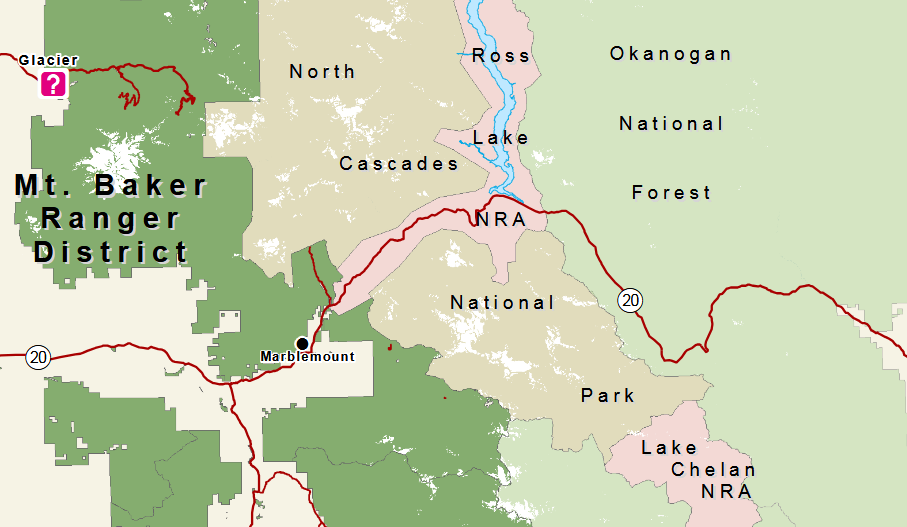
Map showing U.S. Forest Service land and North Cascades National Park Service Complex land. Source: U.S. Forest Service.
This difference matters most for camping. The park complex does not work like a casual “just find a forest road” zone. If you are trying to sleep outside a developed campground, you need to understand where dispersed camping is legal, what land manager controls the area, and what current restrictions apply.
When National Forest campgrounds make sense
National Forest campgrounds make the most sense when your trip is centered on a Forest Service recreation area, not when you are simply trying to sleep anywhere after a long Highway 20 day. Baker Lake is the clearest example: if the lake, boat launch, fishing, paddling, or campground setting is the point, Forest Service campgrounds can be the right fit.
They can also work as backups when park campgrounds are full, but only if the drive, services, season, and reservation setup still fit the trip. Do not assume a National Forest campground near the North Cascades is automatically closer, easier, or more available than a park campground.
- Good fit: Baker Lake trips, lake camping, forest-road access, and trips built around a specific Forest Service area.
- Weak fit: late-night overflow after failing to reserve closer to Newhalem, Diablo, or Marblemount.
- Main tradeoff: more flexibility in some areas, but less uniformity and more site-by-site rule checking.
Dispersed camping is not the same as “camp anywhere”
Dispersed camping is one of the easiest places for visitors to get confused. Some National Forest areas allow it, but that does not mean every pullout, trailhead, riverbank, gated road, or unsigned spot is legal or safe.
Before relying on dispersed camping, check the land manager, road access, fire restrictions, sanitation rules, distance from water, private-property boundaries, and whether the road is actually suitable for your vehicle. A map can make a forest road look simple when the on-the-ground reality is rough, blocked, washed out, or not appropriate for camping.
Forest roads and side trips
Forest roads are not all equal. Some lead to major recreation areas, some lead to trailheads, some are rough but useful, and some are mostly a map temptation. Around Highway 20, this matters because side-road time can quietly consume the day.
Bacon Creek Road is a good example of why this hub exists. It can look like an easy side trip near Marblemount, but the practical value depends on road condition, vehicle fit, expectations, and whether you actually need that kind of rough informal access.
Use forest-road detours only when they serve the trip. If your goal is a first-time North Cascades scenic drive, a major lake stop, or a high-country trailhead, many forest-road experiments are distractions rather than upgrades.
Baker Lake is the clearest Forest Service destination
For most Cascades Field Guide visitors, Baker Lake is the easiest National Forest area to understand as a real destination. It has campgrounds, lake access, boat launches, fishing, paddling, swimming, day-use stops, and lower-elevation trails tied to the Concrete side of the corridor.
That makes Baker Lake different from a random forest-road detour. If your trip is about lake camping, boating, fishing, or a lower-elevation backup, Baker Lake can be the main plan. If your trip is really about Diablo Lake, Newhalem, Washington Pass, or Maple Pass, Baker Lake is usually a separate side trip, not a shortcut.
What to check before relying on National Forest access
National Forest access can change with snow, storm damage, washouts, fire restrictions, campground operations, seasonal gates, road maintenance, and site-specific closures. Always verify the exact road, campground, trailhead, or recreation area before building a trip around it.
- Road conditions: forest roads can be rough, washed out, gated, snow-covered, or unsuitable for low-clearance vehicles.
- Campground status: some campgrounds are reservable, some are first-come, first-served, and some may not have water or full services.
- Passes and fees: trailheads and day-use sites may require a Northwest Forest Pass, Interagency Pass, day-use fee, or campground fee.
- Fire restrictions: campfire rules can change quickly in summer and early fall.
- Dispersed camping legality: verify land manager, local restrictions, sanitation rules, and whether the site is actually appropriate.
- Cascades Field Guide current conditions - start here for the practical trip-planning version.
- Mt. Baker-Snoqualmie National Forest - official Forest Service information.
- Mt. Baker-Snoqualmie current conditions - official road, trail, fire, and closure updates.
- Recreation.gov - campground reservations where applicable.