North Cascades Fees, Passes, and Permits
Last updated: July 2026
North Cascades National Park Service Complex is free to enter, but that does not mean every trailhead, campground, or overnight trip is free. The Highway 20 corridor crosses National Park Service (including National Recreation Areas), U.S. Forest Service, and Washington state lands, and each system uses different passes and permits.
Quick answer
Park entrance and most National Park Service day-use stops: free - no pass or entry fee needed
Rainy Pass, Maple Pass, Blue Lake, Easy Pass, Cutthroat, and many other Forest Service fee sites: use a Northwest Forest Pass, an accepted federal interagency pass, or the site’s $5 day-use payment.
Rockport, Rasar, and Pearrygin Lake state parks: a WA state Discover Pass applies to ordinary day-use parking.
Camping or backpacking: check the separate campground fee, reservation, or backcountry permit. A parking pass does not authorize an overnight stay. Backcountry permits can be requested/issued at the office in Marblemount.
Get weekly North Cascades road, trail, and trip-planning updates
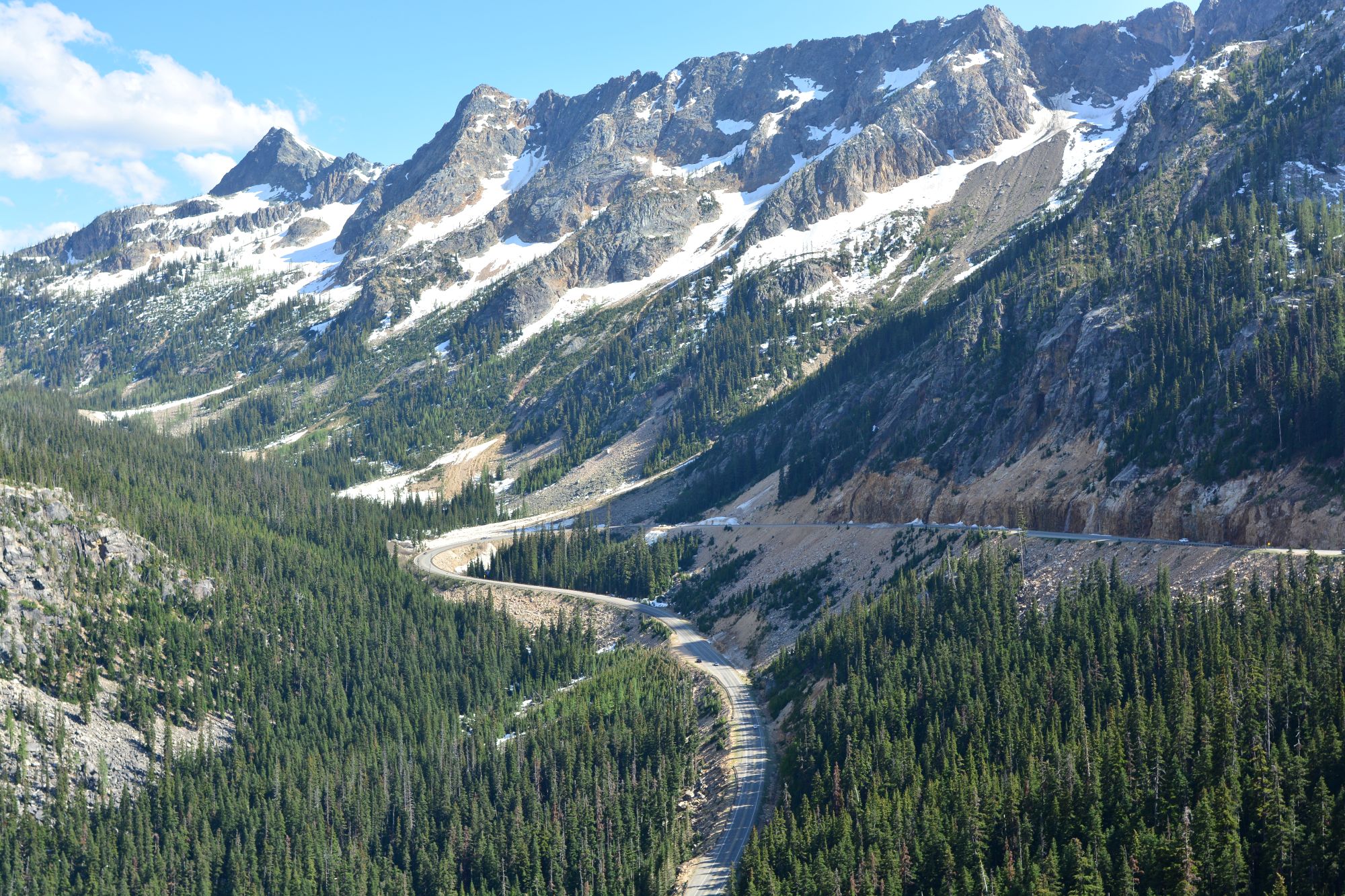
North Cascades Highway viewed from Washington Pass Overlook in early summer | Joe Mabel/CC BY-SA 4.0
Start here: what does your trip need?
Scenic Highway 20 drive with park overlooks and short stops
Usually needed: no entrance pass. Newhalem, the North Cascades Visitor Center, Gorge-area National Park Service stops, Diablo-area park stops, and Ross Dam access do not have an NPS entrance or trailhead parking fee.
Important exception: nearby Forest Service trailheads may charge a day-use fee even though visitors think of them as part of the same North Cascades trip.
Rainy Lake, Maple Pass, Blue Lake, Easy Pass, or Cutthroat
Usually needed: a Northwest Forest Pass, accepted America the Beautiful interagency pass, or the site’s digital day-use payment. These are Forest Service fee sites.
Do before losing service: download the Recreation.gov app if you may use Scan & Pay at the trailhead.
Washington Pass Overlook
Usually needed: no day-use fee. The Forest Service currently lists Washington Pass Observation Site as free.
Main mistake: assuming the free overlook means nearby Blue Lake, Rainy Pass, or Cutthroat trailheads are also free. They have separate fee rules.
Cascade Pass, Sahale Arm, Boston Basin, or Eldorado
Day hike: no NPS parking pass and no backcountry permit for a day trip.
Overnight trip: an NPS backcountry permit is required. Permits for Cascade River Road trailheads have special in-person requirements in Marblemount.
Rockport, Rasar, or Pearrygin Lake State Park
Day visit: a Discover Pass is required for ordinary vehicle parking.
Registered camper: camping fees include day-use parking at the state park where you are staying. Display the camping registration instead of buying a separate Discover Pass for that park.
Developed campground
Usually needed: the campground’s own fee and, when required, a reservation. A Northwest Forest Pass, Discover Pass, or America the Beautiful pass does not replace an ordinary campsite payment.
Backpacking or another overnight backcountry trip
Inside the North Cascades National Park Service Complex: a backcountry permit is required year-round. The parking requirement is a separate question based on where the trip begins.
Use the North Cascades backcountry hiking and camping guide for route-specific permit planning.
The four pass systems that matter most
No entrance pass: National Park Service Complex
There is no fee to enter North Cascades National Park, Ross Lake National Recreation Area, or Lake Chelan National Recreation Area. NPS also states that trails beginning on NPS land do not have trailhead or parking fees.
Does not cover: campground charges, backcountry permits, Lake Chelan dock fees, or adjacent Forest Service fee sites.
Northwest Forest Pass or Forest Service day-use payment
The Northwest Forest Pass is used at participating Forest Service day-use fee sites in Washington and Oregon. The current price is $5 for a day pass or $30 for an annual pass. Many Highway 20 Forest Service sites also offer Recreation.gov Scan & Pay.
Works for: day-use fees at sites such as Rainy Pass, Blue Lake, Easy Pass, and Cutthroat.
Does not cover: Washington state parks, ordinary campground fees, or NPS backcountry permits.
America the Beautiful and other accepted interagency passes
America the Beautiful passes cover federal entrance fees and standard day-use amenity fees. Accepted annual, senior, access, military, and other qualifying interagency passes can substitute for the Northwest Forest Pass at the Highway 20 Forest Service fee sites that honor them.
Does not cover: Discover Pass sites, standard camping charges, reservation fees, or special backcountry permits.
Discover Pass: Washington state-managed lands
The Discover Pass is currently $10 for one day or $45 annually and applies to ordinary day-use vehicle access at Washington state parks such as Rockport, Rasar, and Pearrygin Lake.
Does not cover: NPS or Forest Service sites. Registered state-park campers do not need a Discover Pass at the same park during their stay because their camping registration includes day-use parking.
Campground reservations and backcountry permits
These are permissions for a particular overnight stay, not general parking passes. A campsite reservation covers the campsite named in the reservation. An NPS backcountry permit covers the approved itinerary and camps or zones. Neither automatically pays a separate trailhead fee.
Why one North Cascades trip can use different rules
“North Cascades” is a travel region, not one fee system. A free National Park Service overlook, a Forest Service trailhead charging $5, and a state park requiring a Discover Pass can all appear in the same day’s itinerary.
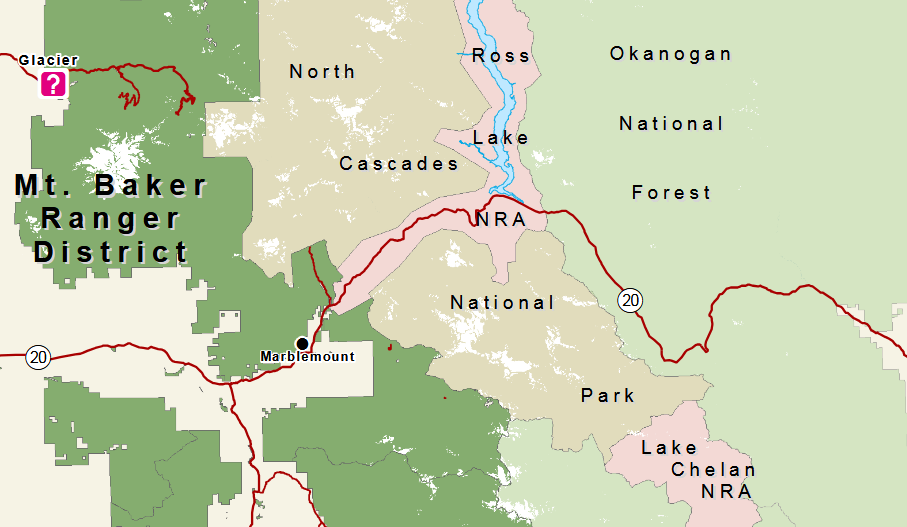
Map showing U.S. Forest Service and North Cascades National Park Service Complex land. Source: U.S. Forest Service.
National Park Service land
No entrance fee and no parking fee at NPS trailheads. Developed camping and backcountry overnights have separate charges or permit requirements.
U.S. Forest Service land
There is no general forest entrance fee, but specific developed day-use sites and trailheads may charge a fee. Check the official page for the exact site instead of assuming every Forest Service parking area uses the same rule.
Washington state parks and other state-managed lands
The Discover Pass applies to motor-vehicle access unless an exemption applies. It is not valid on federal land.
County, town, utility, and other local sites
Local sites set their own rules. Do not display a federal or state pass and assume it covers a county park, municipal lot, or privately operated facility.
West side: state parks and Baker Lake
Rockport State Park
Day use: Discover Pass required for vehicle parking. The park is day-use only and does not offer camping.
Official check: Rockport State Park.
Rasar State Park
Day use: Discover Pass required for vehicle parking.
Camping: campsite or cabin payment is separate. A registered camper displays the camping registration and does not need an additional Discover Pass at Rasar during the stay.
Official check: Rasar State Park.
Baker Lake South and Baker River trailheads
Day use: $5 per vehicle, a valid Northwest Forest Pass, or an accepted interagency pass. The Forest Service lists Scan & Pay at these trailheads.
Important distinction: Baker Lake includes trailheads, campgrounds, boat launches, and day-use areas with different operators and charges. Verify the exact site rather than treating the entire lake as one pass zone.
Official checks: Baker Lake South Trailhead and Baker River Trailhead.
National Park Service stops along Highway 20
Newhalem and the North Cascades Visitor Center
Day use: no entrance or parking fee. Short visitor-center-area walks and ordinary sightseeing stops do not require a park pass.
Gorge Creek Falls and Gorge-area park stops
Day use: no NPS entrance or parking fee.
Diablo Lake, Colonial Creek, and Thunder Knob
Day use: no NPS entrance or trailhead parking fee.
Camping: Colonial Creek campsite charges and reservations are separate from day-use access.
Ross Dam Trail and East Bank access
Day use: no NPS trailhead parking fee.
Overnight: backcountry camping, including Ross Lake boat-in camps, uses the NPS backcountry permit system.
Free parking does not guarantee access
Road closures, seasonal gates, wildfire restrictions, full parking areas, or campground closures can still stop the plan. Use the Current Conditions guide separately from this fees guide.
Cascade River Road and Cascade Pass
Cascade Pass and Sahale Arm
Day hike: no NPS entrance fee, parking fee, or backcountry permit.
Overnight: an NPS backcountry permit is required. There is no camping directly at Cascade Pass; nearby camps use specific permitted itineraries.
Boston Basin and Eldorado approaches
Day use: no NPS parking pass.
Overnight: an NPS backcountry permit is required.
Permit pickup matters here
The NPS currently requires backcountry permits for overnight itineraries beginning at Cascade River Road trailheads, including Cascade Pass and Boston Basin, to be picked up in person at the Wilderness Information Center in Marblemount. NPS states that no permit services are available in Sedro-Woolley.
Use the Cascade River Road guide for road access, parking, vehicle limits, and realistic timing.
Highway 20 fee sites east of Ross Lake
Easy Pass Trailhead
Day use: $5 per vehicle, Northwest Forest Pass, Digital Day Pass, or accepted interagency recreation pass.
Overnight: an NPS backcountry permit is required when camping inside North Cascades National Park.
Official check: Easy Pass Trailhead.
Rainy Pass: Rainy Lake, Lake Ann, and Maple Pass
Day use: $5 per vehicle, Northwest Forest Pass, Digital Day Pass, or accepted interagency recreation pass.
Payment: Recreation.gov Scan & Pay is available. Download the app before the corridor if you may need it.
Camping restriction: no overnight camping within one-quarter mile of Rainy Lake, Lake Ann, Heather Pass, or Maple Pass. Overnight travel into the national park requires an NPS backcountry permit.
Official check: Heather–Maple Pass at Rainy Pass.
Blue Lake Trail
Day use: $5 per vehicle, Northwest Forest Pass, Digital Day Pass, or accepted America the Beautiful interagency pass.
Camping restriction: no overnight camping within one-quarter mile of Blue Lake.
Official check: Blue Lake Trail.
Washington Pass Observation Site
Day use: free. No fee is currently required at the overlook.
Overnight: day use only; overnight camping is not allowed at the observation site.
Official check: Washington Pass Observation Site.
Cutthroat Trailhead
Day use: $5 per vehicle, Northwest Forest Pass, Digital Day Pass, or accepted interagency recreation pass.
Camping restriction: no overnight camping within one-quarter mile of Cutthroat Lake.
Official check: Cutthroat Trailhead.
East side: Pearrygin Lake State Park
Ordinary day visit
Parking: Discover Pass required. The current statewide rate is $10 for one day or $45 annually.
Registered camper
Parking: no separate Discover Pass is required at Pearrygin during the registered stay. Display the camping registration. A Discover Pass is still needed if you drive to a different state park or other state-managed recreation land.
Boat launch
Day visitor: Washington State Parks currently lists a $7 watercraft launch fee in addition to the Discover Pass. Registered campers do not pay the separate launch fee at the park where they are staying.
Official check: Pearrygin Lake State Park.
Campground fees are separate
Free park entrance does not make developed campgrounds free. The National Park Service currently lists these nightly rates:
- Colonial Creek: $24 per night
- Newhalem Creek: $24 per night
- Goodell Creek: $20 per night
- Gorge Lake: $20 per night
- Stehekin campgrounds: $20 per night
- Hozomeen: free
All drive-in campgrounds along State Route 20 use Recreation.gov reservations during their specified reservation seasons. Some may operate first-come, first-served before or after that season. Check the exact campground and dates before relying on availability.
Forest Service and Washington State Parks campgrounds have their own nightly charges and reservation rules. A Northwest Forest Pass covers qualifying day-use fees, not an ordinary campsite. A registered Washington state-park camper uses the camping registration for day-use parking at that same park.
Use the North Cascades Park Complex campground guide or the camping hub for campground comparisons and booking strategy.
NPS backcountry permits: the short version
Required: year-round for every overnight stay in the North Cascades National Park Service Complex backcountry, including designated camps, cross-country zones, climbing itineraries, and Ross Lake boat-in camps.
Current fee: $10 per person age 16 or older, with youth 15 and under free, plus a $6 non-refundable fee.
Availability: approximately 60% of the park’s backcountry campsite inventory can be reserved in advance. The remaining inventory is held for first-come, first-served walk-up permits.
Main permit office: Wilderness Information Center, 7280 Ranger Station Road in Marblemount. NPS currently states that there are no permit services in Sedro-Woolley or Stehekin.
Cascade River Road exception: permits for Cascade Pass, Boston Basin, and other Cascade River Road starts must be handled in person in Marblemount.
Do not rely on this summary alone: availability, pickup procedure, operating hours, bear-canister requirements, and seasonal reservation dates change. Use the current NPS backcountry permit page and the backcountry planning guide.
Fishing, boating, and other add-on fees
Fishing
A valid Washington fishing license is required when state licensing rules apply. A fishing license does not replace the parking pass, launch charge, or backcountry permit for the access site. Use the North Cascades fishing guide for water-specific planning.
Ross and Diablo Lake boat-in camping
Boat-in camps use the NPS backcountry permit system. Treat the camping permit and the logistics of reaching the lake as separate parts of the plan.
Lake Chelan federal docks
From May 1 through October 31, boaters using NPS or Forest Service docks along Lake Chelan need the federal Lake Chelan Dock Permit. The current price is $10 per day or $75 annually.
Washington state-park launches
State Parks currently charges $7 for a daily watercraft launch in addition to the Discover Pass. Registered campers do not pay the separate launch fee at the park where they are staying.
Payment and pass strategy before you lose service
- Choose the exact destination. “Washington Pass area” is not specific enough: Washington Pass Overlook is free, while Blue Lake and Rainy Pass are fee sites.
- Identify the land manager. National Park Service, Forest Service, and Washington state passes are not interchangeable.
- Separate parking from the activity. Check parking, developed camping, and backcountry overnight requirements independently.
- Download the Recreation.gov app. Forest Service pages for Rainy Pass, Blue Lake, Easy Pass, Cutthroat, and Baker Lake trailheads recommend downloading it before the trip so Scan & Pay can work at sites with poor service.
- Save the official site page. Fees, payment methods, closures, and reservation procedures can change after this guide is updated.
Do not buy every pass “just in case”
Start with the stops you will actually use. A scenic NPS day with Newhalem, Gorge Creek, Diablo, and Washington Pass Overlook may require no parking pass. Add Rainy Pass or Blue Lake and a federal day-use pass or payment becomes relevant. Add Rockport State Park and the Discover Pass becomes a separate question.
Mistakes that cause the most confusion
- “The national park is free, so every nearby trailhead is free.” Adjacent Forest Service fee sites use different rules.
- “My Discover Pass works everywhere in Washington.” It does not cover federal land.
- “My America the Beautiful pass covers the state parks.” It covers participating federal entrance and standard day-use fees, not Discover Pass sites.
- “Washington Pass and Blue Lake use the same fee rule.” The overlook is currently free; Blue Lake is a Forest Service fee site.
- “A Northwest Forest Pass pays for my campground.” It is a day-use recreation pass, not a general campsite payment.
- “My parking pass is my backcountry permit.” Parking and overnight authorization are separate.
- “I can resolve a Cascade Pass permit in Sedro-Woolley.” NPS currently directs Cascade River Road permit pickup to the Wilderness Information Center in Marblemount.
- “I can download the payment app at the trailhead.” Service is unreliable; download it before entering the mountain corridor.
Official sources to check
- NPS entrance, campground, backcountry, and dock fees: North Cascades Fees & Passes
- Current NPS backcountry process and pickup locations: Backcountry Permits
- Backcountry reservation dates and availability: Backcountry Reservations
- NPS developed camping: North Cascades Camping
- Federal interagency pass coverage: America the Beautiful Passes
- Washington state-park fees: Washington State Parks Fees
- Discover Pass exemptions for campers and others: When You Don’t Need a Discover Pass
- Forest Service Highway 20 sites: use the individual official trailhead links in the location sections above.
Related Guides
This guide is for trip planning and was checked against official sources. Fees, accepted passes, payment systems, reservation procedures, operating seasons, and closures can change. Check the official page for your exact destination before leaving.